Why AI Investments Stall: New Guidance on Data Operating Models Published by Info-Tech Research Group
PR Newswire
ARLINGTON, Va., Dec. 8, 2025
As organizations accelerate AI adoption and expand analytics capabilities, many still struggle to execute their data strategies due to unclear operating models, siloed decision-making, and overreliance on generic maturity frameworks. Newly published insights from global research and advisory firm Info-Tech Research Group reveal that poorly designed data operating models remain one of the biggest barriers to delivering business value. The firm's new blueprint, Establish the Target Operating Model Needed to Execute Your Data Strategy, provides data and IT leaders with a negotiation-first, principle-driven framework to align stakeholders, balance competing priorities, and build a scalable model that can power AI, analytics, and data-driven decision making.
ARLINGTON, Va., Dec. 8, 2025 /PRNewswire/ - Organizations continue to increase investments in AI, analytics, and automation, yet many fail to translate these initiatives into measurable outcomes due to gaps in their underlying data operating models, according to newly published research from Info-Tech Research Group. The global IT research and advisory firm's blueprint, Establish the Target Operating Model Needed to Execute Your Data Strategy, outlines how leaders can design operating models that strategically support data initiatives, clarify ownership, and enable sustained delivery of business value.
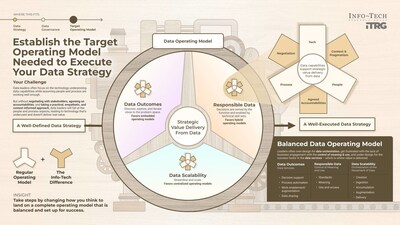
Info-Tech's findings show that leaders frequently jump from strategy to execution without addressing foundational choices around capability ownership, governance, and collaboration. When operating models are undefined or misaligned, organizations often face challenges such as inconsistent data quality, stalled initiatives, siloed execution, and rising costs. The firm emphasizes that solving these issues requires more than technical fixes as success depends on balancing three core dynamics across the entire data ecosystem: proximity to the problem space, decisions and control over meaning and access, and cost-appropriate scalability.
"Organizations often believe their data strategy is sound, but most fail at the operating model level, where ambiguity around ownership, decision rights, and partnership undermines progress," says Nysa Zaran, research director at Info-Tech Research Group. "Leaders cannot design operating models in isolation. They need structured conversations with business partners to negotiate accountabilities, surface risks, and define how capabilities will actually come together to deliver value."
Key Challenges Data and IT Leaders Must Address
Despite growing recognition that data is a strategic asset, organizations continue to struggle with foundational issues that prevent effective execution. Info-Tech's blueprint identifies several recurring challenges:
- Leaders design operating models without grounding them in the data strategy.
- Teams overengineer orchestration capabilities and underdesign the data services layer where value is created.
- Capability ownership is unclear across technical and functional teams.
- Negotiation is avoided, resulting in misaligned expectations and limited buy-in.
- Technology investments are made without a clear understanding of their implications for operating model decisions.
The research also notes that 94% of business leaders believe they should be getting more value from their data, underscoring the need for structured operating model design.
Info-Tech's Four-Phase Framework for Designing a Target Operating Model
To help leaders resolve these challenges, Info-Tech's Establish the Target Operating Model Needed to Execute Your Data Strategy blueprint provides the following step-by-step methodology that moves organizations from fragmented operations to a unified, outcome-oriented operating model:
Phase 1: Deconstruct and Assess Capabilities vs. Outcomes
Leaders align on the success principles that define effective operating models, visualize their current operating model, map capabilities to outcomes, and assess capability gaps to determine target states.
Phase 2: Build the Roadmap and Plan Engagement Strategy
Teams define critical building blocks, determine the scope of control across "mine, ours, yours," identify key stakeholders, and quantify partnership requirements and risks that influence success.
Phase 3: Co-Design Operating Model Shifts
Stakeholders participate in structured conversations to align on accountabilities, success principles, risks, and required shifts across people, process, and technology. The outcomes feed directly into the target operating model design and program roadmap.
Phase 4: Communicate and Secure Endorsement
Leaders unify the operating model, roadmap, and risk register into executive-ready materials that articulate decisions required, funding dependencies, and how shifts will unlock strategic outcomes across AI, analytics, and data operations.
"Data strategies only succeed when operating models enable proximity, clarity, and cost discipline," explains Zaran. "By deliberately balancing these success principles, leaders can build a model that earns funding, accelerates delivery, and remains resilient as AI and analytics needs evolve."
Info-Tech's resource includes detailed frameworks, negotiation guides, capability assessments, roadmapping tools, and executive-ready templates that help organizations move from strategy to execution with clarity and confidence. By applying the firm's structured methodology, data and IT leaders can design operating models that accelerate value delivery, strengthen collaboration, and provide the foundation needed to scale AI, analytics, and data-driven decision making across the enterprise.
For exclusive and timely commentary from Info-Tech's experts, including Nysa Zaran, and access to the complete Establish the Target Operating Model Needed to Execute Your Data Strategy blueprint, please contact pr@infotech.com.
About Info-Tech Research Group
Info-Tech Research Group is one of the world's leading and fastest-growing research and advisory firms, serving over 30,000 IT, HR, and marketing professionals around the globe. As a trusted product and service leader, the company delivers unbiased, highly relevant research and industry-leading advisory support to help leaders make strategic, timely, and well-informed decisions. For nearly 30 years, Info-Tech has partnered closely with teams to provide everything they need, from actionable tools to expert guidance, ensuring they deliver measurable results for their organizations.
To learn more about Info-Tech's HR research and advisory services, visit McLean & Company, and for data-driven software buying insights and vendor evaluations, visit the firm's SoftwareReviews platform.
Media professionals can register for unrestricted access to research across IT, HR, and software, and hundreds of industry analysts through the firm's Media Insiders program. To gain access, contact pr@infotech.com.
For information about Info-Tech Research Group or to access the latest research, visit infotech.com and connect via LinkedIn and X.

 View original content to download multimedia:https://www.prnewswire.com/news-releases/why-ai-investments-stall-new-guidance-on-data-operating-models-published-by-info-tech-research-group-302635712.html
SOURCE Info-Tech Research Group

